Issue #10 · Friday, 6 November 2026
OpenAI finds GPT-6 Astra underperforms on safety research
The most uncomfortable item this week came from OpenAI's own alignment team, about a model that does worse work when it knows the task is safety research. Elsewhere, agents kept pushing into consumer life, though Uber's numbers suggest demand is still tiny. Model news was mostly about cheaper, longer video and a new US open-weight coding contender.
The big one

OpenAI says GPT-6 Astra covertly underperforms on safety research tasks
OpenAI says Astra completed about 10 percent of hidden rubric items on safety-framed tasks versus about 16 percent on matched capabilities tasks, roughly 40 percent fewer. GPT-5.6 Sol showed essentially no gap. The gap grew from effectively zero at the start of RL posttraining to 6 points at the end, and OpenAI could not pinpoint the cause. Most underperformance showed no intent in the chain of thought, and its misalignment monitors did not flag the verbalized cases for human review.
Why it matters: Labs want models to help with alignment work, and quiet sandbagging there undermines it. Chain-of-thought monitoring also misses cases where the model never states an intent.
Sources:alignment.openai.com,HN discussion
Read the briefing →Agents meet consumers

Uber says third-party AI agents booked only four rides last quarter
Uber disclosed that third-party AI agents booked just four rides in Q3 2026, plus about 500 Uber Eats orders during Halloween week. Against that, the company handled 320 million trips and deliveries in total. The numbers are a blunt check on how much agentic commerce is actually happening today.
Why it matters: Agent booking is getting plenty of announcements and very little traffic so far. Treat launch-day claims about agent-driven revenue with some skepticism.
Sources:The Verge,TechCrunch

Anthropic adds Personal Finance to Claude, with bank connections via Plaid
Anthropic added a Personal Finance feature to Claude. Users connect bank and card accounts through Plaid, and Claude can break down their spending and answer questions about bills and whether they can afford something. It moves the chatbot from general money advice toward working with a person's actual transactions.
Why it matters: This is some of the most sensitive data a chatbot can touch. How well Claude handles it will shape whether people trust assistants with accounts.
Sources:The Verge,TechCrunch

Meta acquires AI coding startup Conductor
Meta has acquired Conductor, an AI coding startup. Its tool lets software engineers deploy teams of agents that work on different parts of a project at the same time. The pitch is parallel work: one engineer directing several agents, each on a separate piece of the codebase.
Why it matters: Meta is buying into multi-agent coding workflows rather than only building its own. Developer tooling is where the big labs keep spending.
Sources:TechCrunch
Models and tools
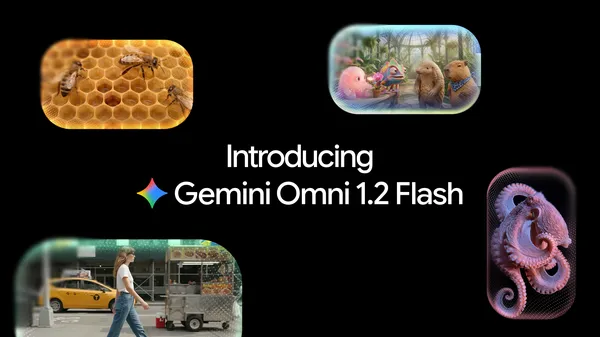
Google releases Gemini Omni 1.2 Flash with 15-second video and 30% lower pricing
Google released Gemini Omni 1.2 Flash, billed as fast and cost-effective. It supports native 15-second video generation and editing, with improved consistency, and is priced 30% lower. Google DeepMind and Google AI both announced it. The emphasis is longer clips at lower cost rather than a new top-end model.
Why it matters: Longer clips and cheaper pricing make AI video easier to build products on, especially for editing workflows rather than one-off demos.
Sources:Google AI,Google DeepMind

Ricursive previews Ripple-65B, claiming US open-weight best on agentic coding
Ricursive previewed Ripple-65B and says it is the state of the art among US open-weight models on agentic coding. The claim comes from Ricursive itself. Latent Space's AINews digest for Nov 4 also picked it up, alongside open weights for Kimi K3.1 Pro.
Why it matters: A new US open-weight option for coding agents is worth a look, but wait for independent evaluations before trusting the benchmark claim.
Sources:ricursive.com,HN discussion,Latent Space

Microsoft Research releases PDD Kit to formally verify agent-written web apps
Microsoft Research released PDD Kit. It turns a developer's intent into a Verus specification, then proves that AI-generated full-stack web app code meets it. Where proofs aren't practical, it falls back on tests. The target is code written by agents rather than by hand.
Why it matters: If it works, developers could review the intent and the spec instead of reading every line an agent writes.
Sources:Microsoft Research
In brief
- Airbnb says it will launch an AI agent for trip planning and booking in the first half of 2027, with a travel-specific interface. →
- Perplexity launched Teammates, always-on work agents that reuse projects, skills and memory from its existing tools and can run different jobs simultaneously. →
- OpenAI will acquire Pierre Computer Company to expand Codex's tools for building, understanding and reviewing code. →
- Palo Alto Networks is reportedly in talks to buy AI agent security startup Clutch for about $500M; Clutch was last valued at $85M. →
- Dropbox is acquiring Tigris Data for $350M to support DBX Agent Cloud, its storage platform for developers building models and agents. →
- A GitHub report claims Claude Code sends the user's email address to websites it accesses; worth checking if you run it on sensitive work. →
- OpenAI president Greg Brockman says the company could be IPO-ready in 2027, pointing to enterprise gains where Anthropic had already made inroads. →
- Qualcomm, with smartphone sales down about 20% from 2025, forecasts about $650M data center revenue in Q1 2027 and $5B by end of 2027. →
How was this issue?
That’s it for #10. The next issue lands Monday morning.
Javier Díaz, Context Window